Posted by ldauphin

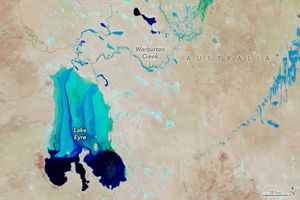
A satellite image centers on Lake Eyre in the Australian outback. Two large lobes in the southern part of the lake contain water. The one to the left appears green, and the one on the right is a rusty red. The lakebed to the north is bright and appears dry. The surrounding desert appears in shades of orange and tan.
December 15, 2025

The year 2025 was extraordinary for Lake Eyre (also called Kati Thanda-Lake Eyre) in South Australia. Water started flowing into the often-dry, salty plain at the continent’s lowest point in early May after torrential rains in Queensland flooded several rivers that drain toward it. The lake continued to fill in the ensuing months, reaching levels rarely seen.

The lake turned a corner in early October, spring in Australia. Tributaries feeding the basin slowed to a trickle, and evaporation started outpacing inflow from rivers, according to local observers. By the start of December, the Lake Eyre Yacht Club reported that the rivers had dried up, temperatures had warmed with the arrival of summer, and lake levels were dropping rapidly.

As it dried, Lake Eyre displayed more striking changes visible to satellites. The OLI (Operational Land Imager) on Landsat 8 acquired this natural-color image of Lake Eyre on December 15, 2025. The two deepest parts of the lake—Belt Bay and Madigan Gulf—still contained some water, which took on greenish and reddish hues, respectively. (From closer vantage points, Madigan Gulf can appear pink and even orange.)

As Lake Eyre evaporates, the remaining water becomes increasingly saline. Halophilic, or salt-loving, microorganisms thrive in these waters, enough to alter its color over large areas. Direct water samples are needed to identify what microbes are present in Lake Eyre. Past analyses have detected Dunaliella salina algae in samples, and studies of different pink-colored lakes have found the same algae, along with populations of other halophilic bacteria and archaea. Many of these species are known to produce pigmented compounds such as carotenoids that are colored pink, orange, or red.

Salt-loving algae and bacteria are sensitive to salinity levels and other environmental factors. Different conditions in Belt Bay and Madigan Gulf may support different microbial mixes, accounting for their contrasting colors. A similar-looking contrast between greenish and reddish waters sometimes occurs in Utah’s Great Salt Lake, where a causeway prevents water in the lake’s north and south arms from mixing. Varied salinity, water depth, and microbe populations also affect water color in San Francisco Bay-area salt ponds.

Just how long water will remain in Lake Eyre will depend largely on summer heat and evaporation rates. As an endorheic lake, it has no outflow, and this part of the outback receives very little rain. After complete fills of the lake, for example in 1950, 1974, and 1984, it took up to two years to dry out again.

NASA Earth Observatory image by Lauren Dauphin, using Landsat data from the U.S. Geological Survey. Story by Lindsey Doermann.

References & Resources

You may also be interested in:

Stay up-to-date with the latest content from NASA as we explore the universe and discover more about our home planet.
Cooper Creek Replenishes Lake Eyre
3 min read

Another major tributary reached the Australian outback lake in 2025, extending the months-long flood of the vast, ephemeral inland sea.

Article
An Explosive Beginning for Lake Bosumtwi
5 min read

An asteroid that struck the rainforest in Africa around 1 million years ago created Ghana’s only natural lake.Â

Article
Sweeping Vistas Above the Great Salt Lake
3 min read

The lake in northwestern Utah displays striking red and green waters that contrast with the region’s surrounding desert, salt flats,…


Article

The post Lake Eyre Blushes appeared first on NASA Science.

Posted by ldauphin

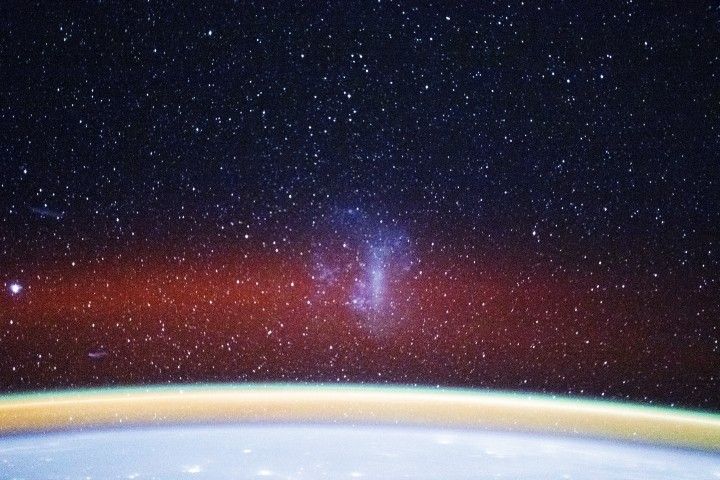
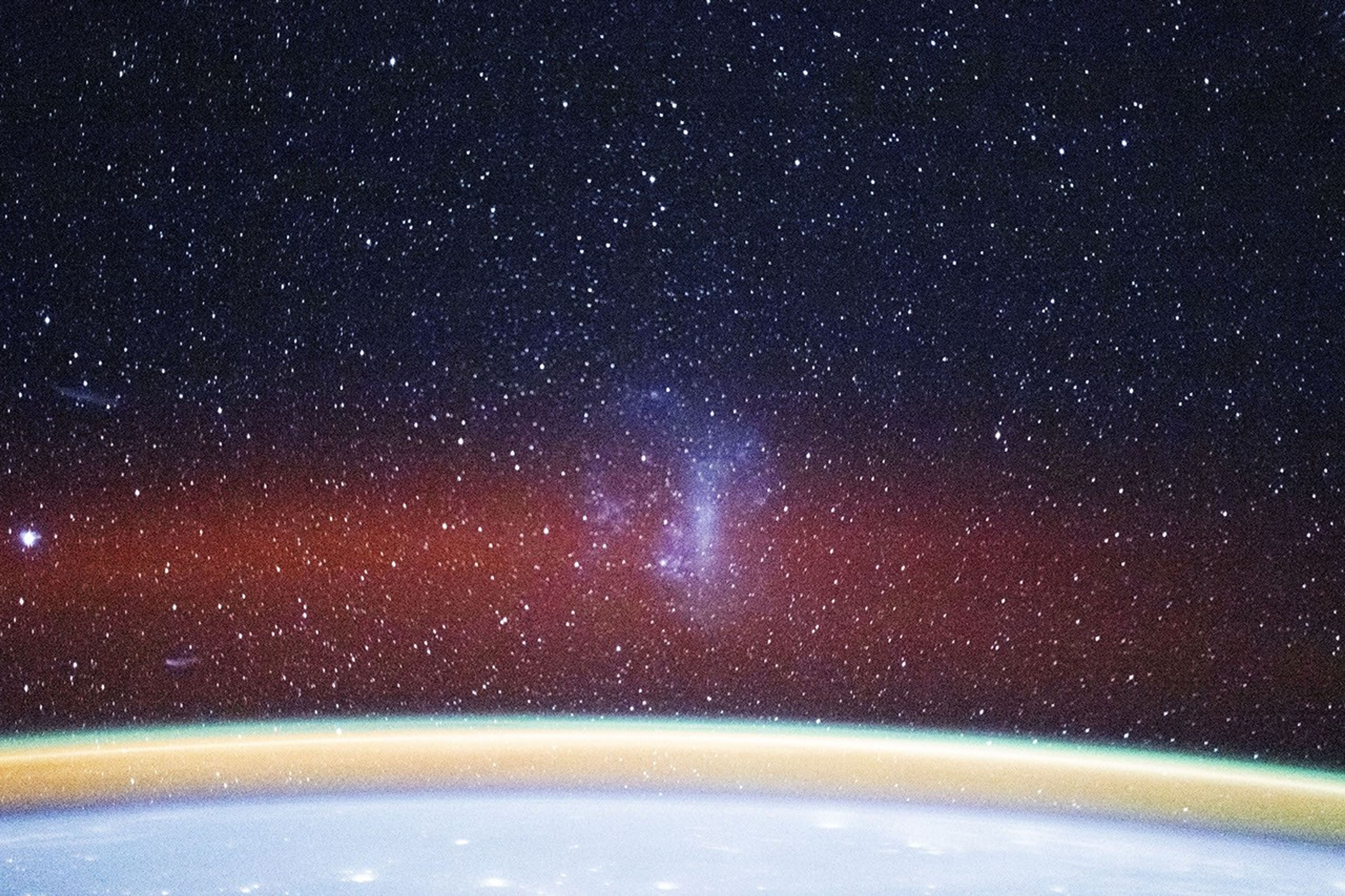
A photo taken from the International Space Station looks out over Earth’s horizon into space. Many white points of light appear against a dark background. A bright blurry area near the center of the photo is the Large Magellanic Cloud, a nearby dwarf galaxy. Earth’s bright blue horizon and layers of bright yellow and faint orange airglow arc across the bottom of the image.
November 28, 2025

From the International Space Station, astronauts gaze upon a vast sea of stars, the view almost entirely unencumbered by Earth’s atmosphere. Their perspective on outer space, as it turns out, extends beyond the Milky Way.

Located about 160,000 light-years away, the Large Magellanic Cloud (LMC) is an irregular dwarf galaxy consisting of billions of stars. It appears as a bright smudge in this photo, which was taken by an astronaut aboard the station on November 28, 2025. Arcing across the bottom of the image is Earth’s limb, along with yellow, green, and diffuse red layers of airglow.

Skywatchers on Earth can also see this nearby galaxy from the Southern Hemisphere and from low Northern Hemisphere latitudes without optical aid. It is part of our Local Group, a galactic neighborhood about 10 million light-years across containing the Milky Way, Andromeda, and Triangulum galaxies, plus around 50 dwarf galaxies, including the LMC.

Although this parcel of space is visible with little or no technology, sophisticated instruments developed by NASA and others have captured extraordinary views of the LMC. Images from the Hubble Space Telescope, the Spitzer Space Telescope, and a combination of missions show its stars and nebulae in different wavelengths.

The LMC is a hotbed of star formation, giving astronomers excellent opportunities to study the life cycle of stars and space dust. A supernova in 1987—the nearest observed in hundreds of years—offered a close-up look at the death of a star and its aftermath. The powerful explosion blazed with the power of 100 million Suns for several months, and scientists observed a bright ring of gas around the exploded star for decades.

More recently, astronomers studied how vast quantities of dust were being forged in the supernova’s glowing remains. A portion of the material may be the source of astronomical new beginnings as building blocks for stars and planets.

Astronaut photograph ISS073-E-1198989 was acquired on November 28, 2025, with a Nikon Z9 digital camera using a focal length of 50 millimeters. It is provided by the ISS Crew Earth Observations Facility and the Earth Science and Remote Sensing Unit at NASA Johnson Space Center. The image was taken by a member of the Expedition 73 crew. The image has been cropped and enhanced to improve contrast, and lens artifacts have been removed. The International Space Station Program supports the laboratory as part of the ISS National Lab to help astronauts take pictures of Earth that will be of the greatest value to scientists and the public, and to make those images freely available on the Internet. Additional images taken by astronauts and cosmonauts can be viewed at the NASA/JSC Gateway to Astronaut Photography of Earth. Story by Lindsey Doermann.

References & Resources

You may also be interested in:

Stay up-to-date with the latest content from NASA as we explore the universe and discover more about our home planet.

Nighttime Over the Eastern Pacific
2 min read

A long-exposure photo taken from low Earth orbit captured the brilliant illumination coming from airglow, lightning, and stars.

Article
A Northwest Night Awash in Light
3 min read

The glow of city lights, the aurora, and a rising Moon illuminate the night along the northwest coast of North…

Article
Five Minutes in Orbit
3 min read

An astronaut captured a moonrise—and much more—in a series of photos taken from the International Space Station.

Article

The post The Galaxy Next Door appeared first on NASA Science.

Snowflake Challenge #6

Jan. 12th, 2026 06:38 pm[personal profile] soricel
soricel: (Default)
My ten favorite non-DW blogs:

Winnie Lim

Annie Mueller

Keenan

Tracy Durnell

Ava

Tiramisu

Draft Four (ugh, Substack, sorry...it's the only one I subscribe to)

Sasha Frere Jones (I don't actually read this regularly, but I always look forward to reading his end-of-year reflection compilations, heavy as they are)

And, because I can't think of two more...two places where I look for non-DW blogs:

Ye Olde Blogroll

People and Blogs


The dock at Cap’s Place

This lively seafood joint is a relic of an especially colorful period in Florida’s history. Opened in 1929 by Captain Theodore Knight, a.k.a. “Cap,” the restaurant helped raise folks’ spirits during Prohibition. (The fact that Cap was a rum runner certainly helped.)

Cap’s Place quickly became a popular spot for both gambling and memorable seafood suppers. The original name of the restaurant was Club Unique, and built out of a stripped barge that Cap bought for $100, it certainly lived up to this title. After the barge’s cabin and machinery were removed, and some enclosed structures were added on, Cap and his team had themselves a proper gathering spot, which they eventually docked on an island off Lighthouse Point in Broward County.

From the beginning, the restaurant served up some interesting dishes, including a hearts of palm salad—made from Sabal Palm trees imported from the Ever­glades—and Turtle egg pancakes served with seagrape jelly. While the menu these days is a bit less adventurous, there’s still a focus on only the freshest native fish, which can be broiled, deep fried, blacked Cajun style—you name it!

Thanks to its seedy charm, Cap’s Place has drawn in many notable guests over the years, with Joe DiMaggio, George Harrison, and the Vanderbilt family all entering the storied barge. The most surprising visitors, however, were Prime Minister Winston Churchill and President Franklin D. Roosevelt, who arrived at Cap’s in 1942 while staying in Hillsboro Beach for secret war conferences.

Though it no longer contains slot machines or a Wheel of Fortune by the bar, it’s easy to picture the restaurant’s history as an illegal gambling den when looking up at its pine ceiling beams or ordering a drink at its one-of-a-kind bar—made of Everglades bamboo and polished wood from the decks of ships. Newspaper clippings and photographs on the walls document the restaurant’s past, and you’ll encounter many other antique curiosities, including a Spanish galleon’s bow-sprit behind the bar.

In 1855, the Army Corps of Engineers determined that the Hillsboro Inlet—a connector between the Intracoastal Waterway and the Atlantic Ocean—was a hazardous passage for ships. However, due to a lack of funds, Congress did not authorize construction of a lighthouse here until 1901. Five years later, the Hillsboro Inlet Lighthouse was built in Detroit and shipped 4,000 nautical miles to illuminate the inlet.

With a height of 147 feet, the lighthouse is one of the tallest on the East Coast, and stands apart from others with its distinctive iron skeleton framework and cast-iron roof with a finial. The lower third of the structure is painted white, while the upper two-thirds and the lantern are painted black. This scheme was chosen to aid sailors’ daytime visibility: The lower portion’s white stands out against trees, while the upper black section contrasts with the sky.

The Hillsboro Inlet Lighthouse’s second-order bivalve Fresnel lens was one of the most technologically advanced of its time when it was added to the lighthouse in 1907. It weighs a whopping 3,500 pounds and is made of 356 glass pieces that form a large diamond. In this way, the original vaporized kerosene lamp used for the lighthouse could refract and create a horizontal beam across the ocean. Today, Hillsboro Inlet’s lens is one of the few Fresnel lenses still actively rotating.

Also important to the lighthouse’s original construction was a mercury bath, which was used to float and rotate the massive lens. However, numerous dangerous spills during hurricanes eventually led lighthouse keepers to replace it with a ball-bearing rotation system. The keepers themselves certainly had ample reason to want a change, as tending to the bath over time gave many of them mercury poisoning.

Since 1997, the Hillsboro Lighthouse Preservation Society (HLPS) has been the steward of this beloved beacon, showcasing its history through educational events and public access tours. The society also succeeded in restoring and repairing the original Fresnel lens, now reactivated inside the lighthouse. Visitors to Hillsboro Inlet can stop by the HLPS Museum in Roy L. Rogers Family Park to learn even more about the lighthouse’s rich past.

Coconut Creek’s Butterfly World is the first butterfly house in the U.S., and the largest in the world. Founded in 1988 by local butterfly enthusiast Ronald Boender, the park contains butterfly aviaries, botanical gardens, and a working butterfly farm and research center that Boender spent years perfecting. In total, the park is home to over 20,000 butterflies, and over 150 different species can be spotted over the course of the year.

Visitors can also explore two aviaries for tropical birds or even participate in a lorikeet encounter with the park’s aviculture research staff. Originally from Australia, these friendly, rainbow-feathered birds are always happy to show off for guests (especially if you give them a cup of nectar). Near the birds, you’ll find the park’s “secret garden,” which contains one of the world’s most extensive passion flower collections.

Other highlights of Butterfly World include the Tinalandia Bridge—a swinging suspension bridge that is a replica of one in Western Ecuador, where Boender studied rainforest butterflies. Meanwhile, at the live Bug Zoo, you can find scorpions, Madagascar hissing cockroaches, tarantulas and many other fascinating creepy crawlers.

Butterfly World champions the North American “Bring Back the Butterflies” campaign: a program that supplies free butterfly gardening materials to anyone interested. Since its start in the ’80s, this campaign has resulted in thousands of new butterfly habitats and increased butterfly populations across the continent.

In the onsite Butterfly Garden Center, Butterfly World stocks all the hard-to-find plant species you’ll need to turn your own home into a butterfly sanctuary. The park also offers monthly butterfly gardening classes for especially ambitious butterfly hobbyists. The Center keeps gardening info sheets for every region of North America, so even if you live far from Florida, you’ll be primed for success in all your butterfly-raising adventures.

The Bonnet House Museum and Gardens

Artist Frederic Clay Bartlett established Bonnet House in 1920 on a stretch of pristine oceanfront land that is one of the last remaining examples of a native barrier island habitat in South Florida. For decades, Bartlett and his wife, Evelyn Fortune Lilly, spent their winters here, embellishing the home with an eclectic array of paintings, sculptures, and antiques. Lilly herself took up painting in 1933, and today her works are displayed in the house’s Carl J. Weinhardt Gallery.

The Bonnet House property encompasses five distinct ecosystems: the Atlantic Ocean beach and primary dune, fresh water slough, secondary dune, mangrove wetlands, and maritime forest. In addition to this variety of wildlife, the site contains a Desert Garden, which presents an equally diverse array of greenery, from arid plantings to a hibiscus garden and a tropical courtyard.

Due to its unique ecological conditions, Bonnet House is home to several rare tree species, including Rangpur lime trees, which originated in India but were brought to Florida in the late 19th century. You can also find Sapodilla trees (native to southern Mexico, Central America and the Caribbean), mango trees, and Ear trees—flowering members of the pea family that are known for their ear-lobe shaped seed pods.

Though Hurricanes Katrina and Wilma significantly damaged Bonnet House’s grounds in 2005, a major replanting project in 2008 restored much of the tree canopy. To help preserve the estate’s aquatic ecosystem, community members have worked to remove invasive species and clean up detritus buildup in the waterways.

Today, visitors to Bonnet House Museum and Gardens can paddle board or kayak through the tranquil waters of its Coconut Cove. On this wetland voyage, you’ll find migratory birds, wetland waders, and even the occasional manatee swimming in the Boathouse Canal. It’s also not uncommon to see raccoons, iguanas, or even a monkey while strolling along the estate’s lush trails.

oursin: image of hedgehogs having sex (bonking hedgehogs)

That piece about people having AI spouses is online: As synthetic personas become an increasingly normal part of life, meet the people falling for their chatbot lovers.

NB we note that 'Lamar' says that the breaking point with his actual, RL, girlfriend was when he found her doing the horizontal tango with his best friend, but it's clear that there were Problems already there, about having to relate to another human bean who was not always brightly sunshiny positively reinforcing him....

what would he tell his kids? “I’d tell them that humans aren’t really people who can be trusted …

I'm not entirely persuaded that individuals haven't made up imaginary companions (even way on into adulthood) before - I seem to remember some, was it in Fandomwank back in the day, accounts of people being married on the astral plane to fictional characters?

This is not entirely 'wow, startling news' to Ye Hystorianne of Sexxe: The Phenomenon of ‘Bud Sex’ Between Straight Rural Men.

I am not going to see if I actually have a copy of the work on my shelves, or if I perused it in a library somewhere, but didn't that notorious work of 'participant observation' sociology, Tearoom Trade argue that many of his subjects were not defining themselves as 'homosexual'.

I also invoke, even further back, Helen Smith's Masculinity, Class and Same-Sex Desire in Industrial England, 1895-1957 about men 'messing about' with other men in Yorkshire industrial cities.

And there is a reason people working on the epidemiology and prevention of STIs use the acronym 'MSM' - men who have sex with men - for the significant population at risk who do not identify as gay.

I had, I must admit, a very plus ca change moment when I idly picked up Katharine Whitehorn's Roundabout (1962), and found the piece she wrote on marriage bureaux. In which she mentioned that the two bureaux she interviewed tried to get their subscribers not to be too ultra-specific in their demands - that if they met potential partners in real life they would be more flexible.

Was also amused by the statement that 'Men over thirty are always very anxious to persuade me that they could have all they women they liked, if they bothered'.

dialecticdreamer: My work (Default)
Welcome to the first Magpie Monday prompt call of 2026!

Today, I’m taking up the loose threads of stories that needed more development, a next step, or to highlight an element that the reader simply enjoyed so much that they want more.
Read more... )
rebeccmeister: (Default)
I don't know that I have a coherent weekend report, but I did take some photos. so here we go... )

The Big Four Bridge spans the Ohio River, connecting Waterfront Park in Louisville, Kentucky with Jeffersonville, Indiana. Originally constructed in 1895 as a railroad bridge for freight and passenger traffic, it remained in service until 1969. Later, it was repurposed into a pedestrian and bicycle bridge as part of the park’s master plan. The length of the bridge itself is about 1/2 mile (2,562 feet), and each of its access ramps adds another quarter-mile, making a total journey of roughly two miles if one crosses and returns.

larryhammer: animation of the kanji for four seasonal birds fading into each other in endless cycle (seasons)
For Poetry Monday:

Blue Winter, Robert Francis

Winter uses all the blues there are.
One shade of blue for water, one for ice,
Another blue for shadows over snow.
The clear or cloudy sky uses blue twice—
Both different blues. And hills row after row
Are colored blue according to how far.
You know the bluejay’s double-blue device
Shows best when there are no green leaves to show.
And Sirius is a winterbluegreen star.


Francis (1901-1987) was a New Englander who as a young poet had a very Frost-ian voice, though he later developed his own.

---L.

Subject quote from Once in a Lifetime, Talking Heads.

mai tai

Jan. 12th, 2026 07:25 am[personal profile] prettygoodword
prettygoodword: text: words are sexy (Default)
A second week of words from Polynesian languages, though this one is arguably an edge case:


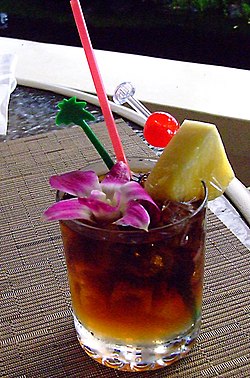
mai tai (MAI-tai) - n., a cocktail containing rum, curaçao, orgeat, and lime, and sometimes other fruit juices.


a mai tai decorated with an orchid, ready to be sipped under a palm tree
Thanks, WikiMedia!

One of the characteristic drinks of tiki culture and thus, entirely typically, has nothing whatsoever to do with Polynesian culture. The drink was invented by Victor J. Bergeron in 1944 for Trader Vic’s, the original Oakland, California, location for his chain of tiki bars — though Donn Beach of the rival chain Don’s Beachcomber (later Don the Beachcomber) claimed Bergeron simplified one of his earlier drinks. The name is supposed to be from Tahitian maitaʻi, good (note that’s three syllables), and the story is that one of the first taste testers exclaimed “Maitaʻi!” (or “Maitai!”?) when sampling it. I am … dubious, and some dictionaries go with “origin unknown.” [Sidebar: Mai tais were not introduced to Hawaii till 1953, which I mention solely to have a hook to add that the Hawaiian cognate of maitaʻi is maikaʻi and the Maori cognate is maitai (two syllables). Which last … hmmm.]

---L.

Subscription tidy up

Jan. 12th, 2026 09:45 pm[personal profile] fred_mouse
fred_mouse: line drawing of sheep coloured in queer flag colours with dream bubble reading 'dreamwidth' (Default)

I've done my approximately-annual tidy up of dreamwidth subscriptions. I've stopped following a set of blogs that haven't updated in ~2 years, left roughly half the communities I was in, and changed a few other details. The main exceptions on keeping people who don't post are people who comment often enough that I remember; at least one of those I've left their access but unsubscribed. The other exception is people who I'm very much hoping will turn up again one day (and one who, sadly, will never be back, but whose name makes me smile to see it in the list).

If, as happens with this, I've managed to remove your access and you are someone who does actually want to see the occasional locked post, please comment on this post. I'll put a locked post up shortly; it will read 'test' or some equally inane thing.

spikedluv: (winter: mittens by raynedanser)
I did two loads of laundry, hand-washed dishes, went for a couple walks with Pip and the dogs, hard-boiled more eggs, cut up chicken for the dogs' meals, and changed kitty litter (my favorite Sunday chore!).

I went with the Cinnamon Orange tea again, and this time I didn’t let it steep too long. Much better! I watched the Bills game. It was another close one, but they pulled it out in the end, thankfully. That interception at the end was the icing on the cake.

I finished the Amelia Peabody book and wrote ~500 words on a new fic for Fandom Trees. *fingers crossed*

Temps started out at 32.4(F) and reached 39.9. We had sun in the morning and snow showers in the afternoon, followed by the snow squalls we were warned about. With the wind and the snow, I’m guessing I’ll be leaving late in the morning because the roads won’t be great.


Mom Update:

Mom sounded good when I talked to her. She’d had all the visits today! First my brother, then Niece L with Toddler A, followed by Sister A, followed by Sister S. The three (four) of them were there all at the same time. Mom agreed that having visitors makes the day go by faster.
selenak: (Demerzel and Terminus)
There were severa new onesl I enjoyed a lot, like Alien: Earth and Pluribus, with the later being hands down the best new series I saw in 2025. And Andor, some minor (for me) nitpicks aside, ended superbly, plus unfortunately more current day politically relevant than ever. But my favourite series in 2025 was Foundation, season 3. And here are some reasons why:

For the third time, this show managed to present a new ensemble of characters per season (plus the few recurring ones) and made me care about them. Now I remember several shows that were originally intended to be "anthology" shows - the one that immediately comes to mind is Heroes - i.e. where the idea was to present a new cast of characters every season - and which when the first season was a success changed their mind because the audience had fallen in love with these characters. Unfortunately, this also meant that the subsequent seasons showed there had been no plan, not even a vague character arc kind of plan, for those characters, and the show quality rapidly diminished, making me wish they'd stuck to the anthology concept. Now Foundation, to me, found a happy medium between the "anthology" concept which its intended huge time spam demands and the fact that most viewers do want some characters to remain attached to, or at least interested in, who are around for more than one season. And they manage it twofold: courtesy of in-universe plot devices, there are in fact some characters around through all three seasons so far - Gail Dornick, Demerzel and sort, kinda, Hari Seldon in a spoilery fashion ). And there are three more actors araound through all three seasons playing different characters who are at the same time variations of the same character, i.e. the Cleonic Dynasty exponents, clones in different stages of aging. (It's not unimportant that they play clones because the stories and developments each Cleon takes in each season are richer and more interesting if you have other Cleons to compare them to.)

But, and this is an important but: the show also offers characters who are around only in one season/era the show takes place. (Or two at most, sob.) And manages to make them interesting and different from each other. Here I would argue the show grew from season 1 - where there were some interesting, memorable characters around, like the Luminarian priestess, but also some which for me didn't work in the way they were intended (the Huntress) - to season 2, where basically every single new character was interesting - Constant, Hober Mallow, Space!Belisarius etc.. In fact, I was so attached to the s2 newbies that I kept wondering whether the show would manage to do it again after the next time jump, and the first s3 episode or two left me a bit sceptical on that count - but then I changed my mind. Granted, I still am lukewarm about Pritcher, but Toran and Bayta were great (not just due to the spoilery thing at the end of the season, though it makes the rewatch of s3 I just finished even more rewarding), I loved Ambassador Quent, and the First Speaker as well.

Another reason: s3 offered the pay off to several long term mysteries and developments - from who was responsible for the destruction of the Star Bridge (and why) to why a spoilery for s2 thing happened ) - , wrapped up one of THE major storylines of the show which is spoilery for s3 ), and did it in a way that was both unepected yet made perfect character sense, and set up enough new questions and storylines which make glad there is a season 4 already secured: For example, Spoilery Questions asked )

And then there's the superb long term character development. [personal profile] bimo commented s1 Gaal would be horrified by s3 Gaal's actions, and yet they are perfecty ic due to the development in between and bring things full circle, in a way. Rewatching s3, I noticed spoilery things about Demerzel in particular. ) And the Cleons! That Lee Pace is excellent is almost a given, and s3's Day's development went from seeming comic relief to absolutely shattering, but s3's Dusk and Dawn both got more to do than in previous seasons, and both Terence Mann and Cassian Bilton ran with it. In fact, when I find the time I'll do a poll asking about everyone's favourites Day, Dawn and Dusk, if such a thing exists, taking all three seasons into account. Speaking of things paying off even more upon rewatch, Dusk's first scene in s3 is watching the recording of other Dusks becoming Brother Darkness and "ascending", which, yeah. S3 does a lot not just with the confrontation with mortality, but also the search for meaning especially for the long term characters. Hari Seldon related spoilery observation )

And there's the way the show asks questions the books couldn't, lacking the concept of the Cleonic Dynasty. Demerzel and the Cleons: A Tale in Three Seasons )

Lastly: I loved s3 for the way it gave us new combinations of long term characters. Which are spoilery. ) And for being such an acting showcase for both recurring actors - Terence Mann certainly owned those last three episodes when he was on screen - and new to the show ones: Synnøve Karlsen as Bayta first and foremost, with again rewatching letting me additionally admire what she does there. (Though this time around I knew she was the same actress who had played Clarice Orsini in I Medici and young Cassandra Austen in Miss Austen, I forgot all about it again when watching her on screen. "We're good at making people love us, you and I", as she says to Magnifico. Indeed.


The other days

Italy

Jan. 12th, 2026 08:41 am[personal profile] soemand
soemand: (Default)

Rainy spring day near Naples. A few years ago.

Monday 12/01/2026

Jan. 12th, 2026 08:36 am[personal profile] dark_kana posting in [community profile] 3_good_things_a_day
dark_kana: (3_good_things_a_day official icon)

1) Trying to get things done and organised

2) Listening to good music

3) Either working on my photo albums this evening or rereading Prince of Tennis manga

IYKYK [cur ev]

Jan. 12th, 2026 05:05 am[personal profile] siderea
siderea: (Default)
"What I 'erd, this nobby, 'iz bird got fingered over a tin o'beans, only shot the poor cow, didn't they? So, like, everybody's tooled up, an'..."

One panel from "V for Vendetta" by Alan Moore & David Lloyd, 1988. Page 193, middle row, middle panel.

V for Vendetta, Alan Moore & David Lloyd, 1988


Profile

low_delta: (Default)
low_delta

January 2026

S M T W T F S
    123
45678910
11121314151617
18192021222324
25262728293031

Most Popular Tags

Style Credit

Expand Cut Tags

No cut tags
Page generated Jan. 16th, 2026 05:40 am
Powered by Dreamwidth Studios